

Product Center
Silicon capacitors, silicon resistors and silicon inductors, with customization from standard selection to dimensions, parameters and packaging.
Ultra-High Frequency
Ultra-high-frequency surface-mount silicon capacitors for 47–110 GHz ultra-high-speed optical module signal chains. Capacitance covers 10 nF–47 nF, maximum operating frequency is 110 GHz (measured), and insertion loss is < 0.5 dB at 67 GHz. 01005 packages deliver 10 nF and 0201 packages deliver 22 nF, combining high capacitance and ultra-high-frequency performance in an ultra-small footprint—a key component for AC coupling in 1.6T/3.2T/6.4T optical modules and co-packaged optics.
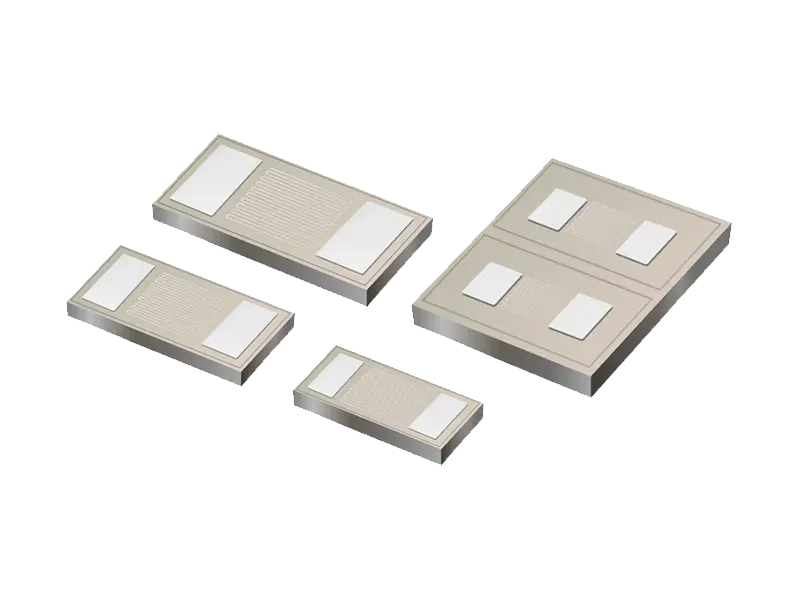
Specifications
10nF–47nF · 11–50V · 110GHz
| Parameter | Value |
|---|---|
| Capacitance range | 10 nF–47 nF |
| Withstand voltage | 11–50 V |
| Max frequency | 110 GHz (measured) |
| Insertion loss at 56 GHz | < 0.5 dB |
| Operating temperature | −55 to +150°C |
| Device type | surface mount |
| TCC | ≤ 70 ppm/K |
| Leakage current | < 1 nA @ UR |
| Aging | capacitance change < 1% @ 125°C/1000 h |
Specification Table
Supports everything from standard selection to size, parameter and package customization.
| Model | Cap (nF) | Status | BV (Vdc) | Size Code (EIA) | POD Dimension (mm) | Typ. Thickness (μm) | Download |
|---|---|---|---|---|---|---|---|
LXF103SA1K0112 | 10 | MP | 11 | 01005 | 0.42*0.22 | 100 | |
LXF223SA1K0092 | 22 | MP | 9 | 01005 | 0.42*0.22 | 100 | |
LXF103AA1K0112(array) | 10 | MP | 11 | 01005 | 0.42*0.46 | 100 | |
LXF223AA1K0092(array) | 22 | MP | 9 | 01005 | 0.42*0.46 | 100 | |
LXF103SA2K0112 | 10 | MP | 11 | 0201 | 0.62*0.32 | 100 | Download |
LXF103SA2K0302 | 10 | MP | 30 | 0201 | 0.62*0.32 | 100 | |
LXF223SA2K0112 | 22 | MP | 11 | 0201 | 0.62*0.32 | 100 | Download |
LXF473SA2K0112 | 47 | MP | 11 | 0201 | 0.62*0.32 | 100 | Download |
LXF223AA2K0112(array) | 22 | MP | 11 | 0201 | 0.62*0.66 | 100 | |
LXF124SA5K0112 | 120 | MP | 11 | 0402 | 1.02*0.52 | 100 |
Applications
1.6T / 3.2T / 6.4T optical module Tx/Rx channel AC coupling
CPO / LPO co-packaged optical modules
On-board optical engine
112G / 224G SerDes AC coupling
PCIe 6.0 / 7.0 signal integrity
FAQ
FAQ
Can silicon capacitors be mounted directly on a chip?
Yes. Silicon capacitors can be mounted on the ball side or backside of a SoC, connecting directly to the chip without PCB routing and greatly reducing power-loop inductance. They are an effective PDN decoupling solution and can also be co-packaged with the chip.
How high a temperature can silicon capacitors withstand? What about long-term reliability?
They can operate at up to 150 °C. The 49-terminal 2 μF product is AEC-Q200 qualified. Leakage current is < 1 nA at RVDC, the capacitance voltage coefficient is < 0.1%/V, and capacitance aging is negligible.
What is the upper frequency limit of silicon capacitors?
Verified operation extends to 110 GHz (01005 22 nF product). Insertion loss at high frequencies is significantly better than conventional ceramic capacitors, making the parts suitable for 1.6T / 3.2T optical modules, 6.4T NPO and other ultra-high-speed applications.
Why can silicon capacitors achieve such high capacitance in such a small package?
The 3D deep-trench structure greatly increases the effective electrode area within a limited footprint. The latest 01005 package has achieved 22 nF / 11 V, more than double the previous 10 nF generation.
What is the essential difference between silicon capacitors and MLCCs?
Silicon capacitors use a semiconductor wafer-level process to form a three-dimensional deep-trench structure in a silicon substrate; MLCCs are ceramic multilayer sintered devices. As a result, silicon capacitors offer significantly lower ESR/ESL, better capacitance accuracy and batch consistency, and a thinner profile that can be co-packaged with the chip. Their capacitance range is smaller and unit cost is higher. The two are complementary, not a simple replacement.
Do you have automotive-grade products?
The full product line covers AEC-Q200 certification requirements. Silicon capacitors, inductors, and resistors all have automotive-grade capability and can be used in automotive electronics and LiDAR.
Can you support system-level joint validation?
Yes. Launchip can work with your application engineering team to build a test platform and evaluate device performance in the real system. This is a key way we advance new applications.
How do I request samples?
Contact the relevant sales owner directly (different contacts for optical communications, LiDAR, and high-frequency power / chip silicon capacitors).

Collaboration and Contact
Talk with our application engineering team about 3D silicon capacitors, silicon inductors and silicon resistors for AI computing, optical communications, LiDAR and other demanding applications.


